
Anúncios
Are you ready to redefine your fantasy football experience and dominate your league in 2026? The landscape of fantasy sports is constantly evolving, and the days of purely gut-feeling drafting are fading fast. To truly excel and consistently maximize your points per game, a sophisticated, data-driven approach is no longer an option—it’s a necessity. This comprehensive guide will delve into the cutting-edge strategies for Fantasy Football Optimization, aiming to boost your roster’s performance by a significant 20%.
The goal isn’t just to win a single week; it’s to build a resilient, high-scoring machine that consistently outperforms the competition. We’ll explore how to leverage advanced analytics, understand player value beyond surface-level stats, and make informed decisions that translate directly into more points on your scoreboard. Get ready to transform your fantasy football strategy from casual participation to calculated conquest.
The Evolution of Fantasy Football Optimization: Beyond Basic Stats
For years, fantasy football managers relied on easily accessible statistics: passing yards, rushing touchdowns, receiving yards. While these remain important, the true edge in modern fantasy football comes from digging deeper. Fantasy Football Optimization now demands an understanding of advanced metrics, predictive modeling, and situational analysis. We’re talking about going beyond the box score to understand efficiency, opportunity, and future potential.
Understanding Advanced Metrics for Superior Roster Construction
To achieve a 20% increase in points per game, you need to identify players who are undervalued by the general fantasy public but possess underlying metrics that signal elite performance. This involves a shift from simply looking at total points to analyzing efficiency and opportunity. Here are some key advanced metrics to integrate into your analysis:
Anúncios
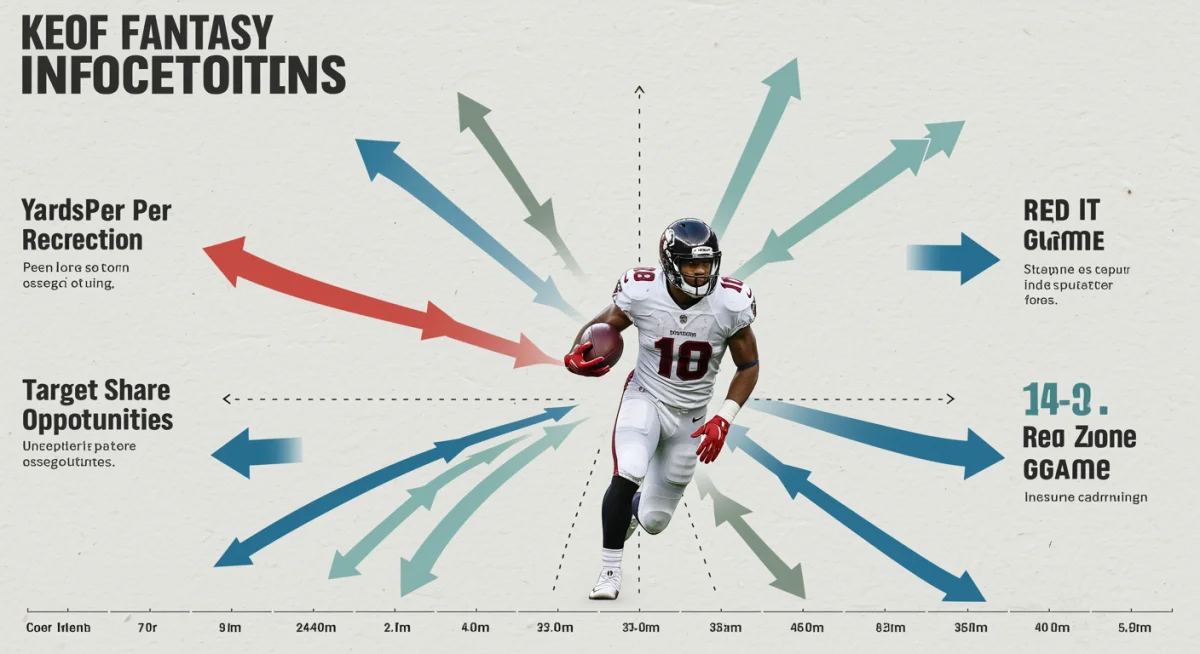
- Target Share (TS): For wide receivers and tight ends, this is crucial. A high target share indicates a player is a primary option in their team’s passing game, leading to more opportunities for catches and yards. A receiver with a lower total yardage but a high target share on a run-heavy team might be a breakout candidate if their team’s offensive philosophy shifts, or if a high-volume pass-catcher departs.
- Red Zone Opportunities (RZO): Touchdowns are king in fantasy football. Tracking a player’s red zone targets (for receivers/tight ends) or red zone carries (for running backs) provides insight into their scoring potential, even if their overall volume isn’t through the roof. A running back with fewer total carries but a high percentage of red zone carries is a touchdown-dependent but high-upside play.
- Yards Per Route Run (YPRR): This metric measures a receiver’s efficiency. It helps identify receivers who are making the most of their routes, suggesting talent and effectiveness regardless of overall team passing volume. High YPRR often correlates with future success.
- Opportunity Share: For running backs, this combines their percentage of team carries and targets. It gives a more complete picture of their role in the offense compared to just looking at carries.
- True Air Yards (TAY): This metric measures the distance the ball travels in the air on pass attempts to a specific receiver. It’s a better indicator of a receiver’s role in the deep passing game than just looking at receiving yards. Players with high TAY often have high upside for big plays.
- Expected Points Added (EPA): While more complex, understanding EPA can help evaluate how much a player contributes to their team’s scoring drives. It can be particularly useful for quarterbacks and running backs.
By focusing on these deeper metrics, you can uncover hidden gems and avoid overpaying for players whose surface-level stats might be inflated by unsustainable factors. This forms the bedrock of effective Fantasy Football Optimization.
Pre-Draft Strategies: Laying the Foundation for 20% PPG Growth
The draft is where championships are often won or lost. Your pre-draft preparation and in-draft decisions are paramount to achieving significant points-per-game improvement. This isn’t about memorizing rankings; it’s about building a robust, adaptable roster.
Advanced Player Valuation and Tier-Based Drafting
Instead of relying solely on ADP (Average Draft Position), develop your own player valuations based on the advanced metrics discussed above. Create tiers for each position, grouping players with similar projected value. This allows for flexibility during the draft. If your top-tier running back is gone, you can confidently pivot to another player in the same tier, rather than reaching for a lower-value player.
Anúncios
- Quarterback Strategy: The “late-round QB” strategy remains viable, but don’t ignore the top-tier rushing quarterbacks who offer a high floor and ceiling due to their dual-threat ability. Analyze their rushing upside and projected passing volume.
- Running Back Strategy: “Workhorse” backs with high opportunity share are gold. Look for backs who are involved in both the running and passing game, especially those with significant red zone touches. Be wary of committee backfields unless you can accurately predict the primary scorer.
- Wide Receiver Strategy: Target share and red zone opportunities are key here. Look for young, ascending receivers with high YPRR who are poised for increased roles. Don’t shy away from players on less efficient offenses if they command a high target share—volume often trumps efficiency over a full season.
- Tight End Strategy: This position can be a wasteland. If you miss out on a top-tier option, consider streaming or targeting late-round tight ends with high athletic profiles or who are in offenses known to feature the tight end in the red zone.
Identifying Value in “Dead Zones” and “Sweet Spots”
Every draft has “dead zones”—rounds where the value at certain positions drops off significantly—and “sweet spots” where an abundance of talent at a particular position can be found. Understanding these dynamics is crucial for Fantasy Football Optimization.
- Running Back Dead Zone: Often occurs in rounds 3-6, where the top-tier backs are gone, and the remaining options are often in committees or have significant question marks. This is a good time to pivot to wide receivers.
- Wide Receiver Sweet Spot: Can often be found in rounds 3-7, where a plethora of talented receivers with high upside are available. You can build a strong receiving corps here.
By identifying these zones, you can adjust your draft strategy on the fly, ensuring you’re always maximizing value with each pick. This flexible approach is a cornerstone of boosting your points per game.
In-Season Fantasy Football Optimization: The Art of Continuous Improvement
The draft is just the beginning. True Fantasy Football Optimization requires constant vigilance and strategic decision-making throughout the season. This means mastering the waiver wire, making intelligent trades, and understanding matchup advantages.
Waiver Wire Wizardry: Spotting Breakouts and Streaming Options
The waiver wire is a goldmine for increasing your points per game. Don’t just pick up players based on last week’s performance. Instead, look for underlying indicators:
- Increased Opportunity: A starting player gets injured, opening up a significant role for a backup. Investigate their talent and coaching staff’s trust.
- Target Share Spike: A receiver or tight end who saw a sudden, significant increase in targets, even if their stat line wasn’t spectacular, could be poised for a breakout.
- Red Zone Usage: A player who suddenly starts getting red zone touches is a prime waiver target, especially for touchdown-dependent positions.
- Matchup Streaming: For positions like QB, TE, and Defense/Special Teams (DST), streaming based on favorable weekly matchups can significantly boost your PPG. Research opposing team’s defensive weaknesses.
Utilize advanced metrics to evaluate waiver wire targets. Don’t be afraid to drop underperforming players to take a chance on high-upside options. This aggressive approach is vital for continuous roster improvement.
Strategic Trading: Buy Low, Sell High, and Consolidate Talent
Trading is perhaps the most challenging, yet rewarding, aspect of Fantasy Football Optimization. The goal is to improve your roster’s overall points per game by acquiring players with higher projected value or by consolidating depth for elite talent.
- Buy Low: Target players who are underperforming but have strong underlying metrics and a favorable schedule ahead. Their owners might be frustrated and willing to sell at a discount. Look for players who have faced tough defenses or had unlucky touchdown droughts.
- Sell High: Trade players who have significantly overperformed their expected value, especially if their success is unsustainable (e.g., a backup running back who had a massive game due to a fluke play). Package them with other players to upgrade a weaker position.
- Consolidate Talent: If you have an abundance of depth at one position, consider trading two solid players for one elite player. While it reduces your bench depth, it significantly raises your starting lineup’s PPG ceiling.
- Understand Your League: Every league has different trading dynamics. Some managers are more willing to trade than others. Understand your league mates’ tendencies and target those who are more open to deals.
Always approach trades with an analytical mindset, focusing on how each transaction impacts your team’s projected points per game. Don’t make emotional trades.
Leveraging Predictive Analytics and Machine Learning for 2026
The future of Fantasy Football Optimization lies in increasingly sophisticated predictive analytics and even machine learning models. While not every fantasy manager has access to these tools, understanding their principles can still inform your strategy.
The Role of Data Science in Projecting Performance
Data scientists are building models that incorporate hundreds of variables, from historical performance and advanced metrics to strength of schedule, weather conditions, and even coaching tendencies. These models aim to predict player performance with greater accuracy than traditional methods.
- Regression Analysis: Used to identify relationships between various player statistics and actual fantasy points. This helps in understanding which metrics are truly predictive.
- Projection Systems: Many reputable fantasy sites use complex algorithms to generate weekly and seasonal projections. While not perfect, they offer a data-backed baseline for player expectations.
- Strength of Schedule (SOS): Consistently integrate SOS into your weekly and season-long planning. A player with a difficult upcoming schedule might be a sell-high candidate, while one with an easy schedule could be a buy-low or breakout candidate.
While you might not be building these models yourself, you can certainly benefit from their outputs. Many fantasy football tools and websites are integrating these advanced analytics into their offerings, making them more accessible to the average user. Learning to interpret these outputs is key to superior Fantasy Football Optimization.
Situational Awareness: Injuries, Bye Weeks, and Playoff Schedules
Beyond the numbers, situational awareness plays a critical role in maintaining a high PPG. Injuries, bye weeks, and the playoff schedule can dramatically impact your roster’s performance.
Navigating Injuries: The Next Man Up
Injuries are an unfortunate but inevitable part of fantasy football. Your ability to react swiftly and intelligently can save your season:
- Monitor Injury Reports: Stay up-to-date with official injury reports throughout the week. Don’t wait until Sunday morning to find out your star player is out.
- Handcuffing: For your elite running backs, consider drafting or acquiring their direct backup (handcuff). If your starter goes down, you immediately have a high-upside replacement.
- Waiver Wire Reaction: When a key player gets injured, immediately check the waiver wire for their replacement. Often, the “next man up” can provide significant value.
Bye Week Management: Planning for the Gaps
Bye weeks can cripple a poorly managed roster. Plan ahead:
- Draft with Bye Weeks in Mind: Try to avoid drafting too many key players with the same bye week, especially at the same position.
- Stash Players: Use your bench spots to stash high-upside players who have already had their bye, or those who have an upcoming favorable schedule.
- Waiver Wire Streaming: Utilize the waiver wire to find one-week fill-ins for bye-week players.
Optimizing for the Fantasy Playoffs
True champions don’t just make the playoffs; they dominate them. This requires foresight:
- Strength of Playoff Schedule (SOS): During the mid-to-late season, start examining the strength of schedule for your players during the fantasy playoff weeks (typically Weeks 14-16 or 15-17).
- Trade for Favorable Matchups: If a player on your team has a brutal playoff schedule, consider trading them away for a player with an easier path, even if their overall season-long projections are similar.
- Stash Playoff-Reliant Players: Identify players who might not be stars all season but consistently perform well against specific opponents or during specific times of the year.
These situational factors are often overlooked but are crucial for consistent Fantasy Football Optimization, especially as the season progresses.
Building a Resilient Roster: Depth and Flexibility
A high-performing fantasy football roster isn’t just about having a few star players; it’s about having depth and flexibility across all positions. This resilience ensures that your points per game don’t plummet in the face of injuries or bye weeks.
The Importance of Bench Management
Your bench is not just a holding pen for future starters; it’s an active part of your Fantasy Football Optimization strategy. Use your bench wisely:
- High-Upside Stashes: Keep players with high ceilings, even if they aren’t currently producing. This could be a rookie who is expected to see an increased role, or a player returning from injury.
- Handcuffs: As mentioned, securing the backup to your top running backs is a smart move.
- Bye Week Fill-ins: Hold onto players who can step in during your starters’ bye weeks, especially at positions where waiver wire options are scarce.
- Speculative Adds: Don’t be afraid to take a flyer on a player who is trending upwards or has a favorable upcoming schedule.
Positional Scarcity and Draft Strategy
Understand which positions are scarce and which are deep. This impacts your draft strategy. For example, if reliable tight ends are few and far between, investing in one early might be a savvy move to secure a consistent PPG advantage at that position.
- Running Back – Historically Scarce: Top-tier running backs are often limited, making them highly valuable. Prioritizing them early can secure a consistent points foundation.
- Wide Receiver – Often Deep: There’s usually a larger pool of starting-caliber wide receivers, allowing for more flexibility in drafting. You can often find great value in the middle rounds.
- Quarterback – Varies: The depth of the QB position can fluctuate. In some years, there are many viable starters; in others, a clear top tier emerges. Adjust your draft strategy accordingly.
By building a deep and flexible roster, you minimize the impact of unforeseen circumstances, helping you maintain a high points per game average throughout the entire season, leading to superior Fantasy Football Optimization.
The Mental Game: Avoiding Biases and Staying Objective
Even with all the data and strategies, human biases can derail your Fantasy Football Optimization efforts. Staying objective is crucial.
Common Biases to Avoid:
- Recency Bias: Overvaluing a player based on their last game rather than their season-long trend or underlying metrics.
- Confirmation Bias: Only seeking out information that confirms your existing beliefs about a player, ignoring contradictory evidence.
- Anchoring Bias: Over-relying on the first piece of information you receive about a player (e.g., their pre-season ranking) and not adjusting your perception as new data emerges.
- Sunk Cost Fallacy: Holding onto a struggling player simply because you invested a high draft pick in them, rather than cutting bait and finding a better option.
Cultivating an Objective Mindset:
- Regularly Review Your Roster: Don’t get attached to players. Objectively assess their performance and future outlook.
- Consult Multiple Sources: Get projections and analysis from various reputable fantasy football experts and data providers.
- Embrace Contrarian Views: Be open to the idea that a player you like might actually be a bad pick, or a player you dislike might be undervalued.
- Process Over Results: Focus on making sound, data-driven decisions, even if they don’t always pay off immediately. Over the long run, a good process leads to good results.
Mastering the mental game is just as important as mastering the data. An objective approach ensures that your Fantasy Football Optimization efforts are not undermined by emotional decisions.
Conclusion: Your Path to 2026 Fantasy Football Dominance
Achieving a 20% increase in your fantasy football points per game by 2026 is an ambitious but entirely attainable goal. It requires a commitment to continuous learning, a deep dive into advanced analytics, and a proactive approach to roster management. By integrating the strategies outlined in this guide—from understanding advanced metrics and employing sophisticated draft tactics to mastering the waiver wire, making intelligent trades, and maintaining an objective mindset—you will build a championship-caliber team.
The landscape of fantasy football is dynamic, but the principles of data-driven Fantasy Football Optimization remain constant. Start your preparation now, embrace the numbers, and get ready to celebrate your victories in 2026. The era of the data-savvy fantasy manager is here, and with these tools, you’ll be at the forefront.